
Three Essential Resources I Regularly Share with Clients
Practical support for Autistic and ADHD adults

If I were to include every resource I signpost to in my work as a counsellor it would be a very extensive list.
Nothing works for everyone, even if the topic covered feels highly relevant. But the frequency with which these resources come up - and the positive feedback that many clients give about them - makes me think they’re worth sharing with a wider audience.
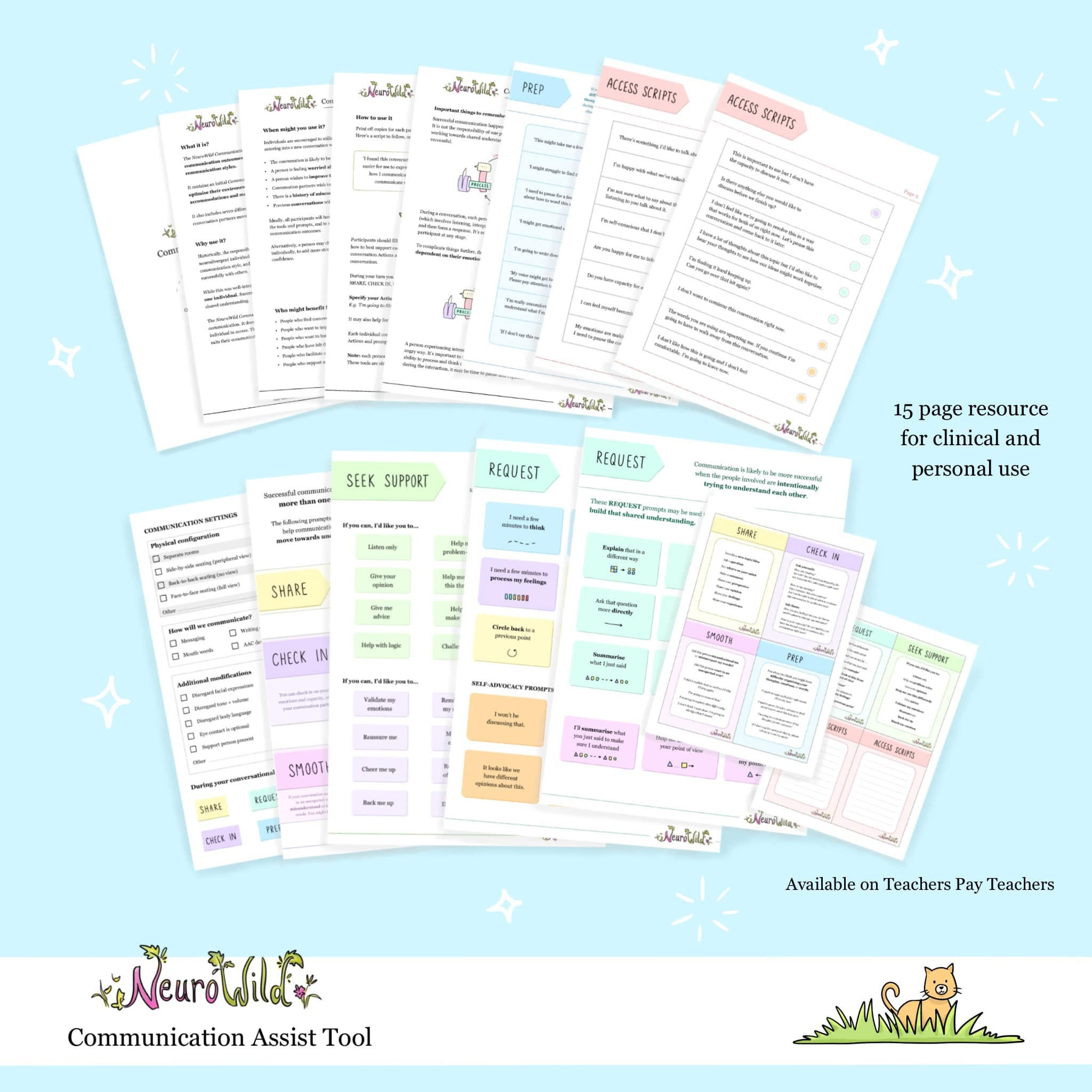
NEUROWILD COMMUNICATION ASSIST TOOL (CAT)
Resource by Em Hammond (2024)
In everyday life, people rarely stop to think about different communication styles. Neuronormative communication is so embedded that people may go through life never having realised that differences exist beyond a few well known examples such as sign language. But communication runs much deeper than simply whether we’re using mouth words or augmentative and alternative communication (AAC). This lack of awareness can lead to enormous difficulties when people have mismatched communication styles, and no idea this is happening.
Some process quickly and internally. Some need to vocalise to order their thoughts. Others don’t have an internal monologue and can only gain clarity by writing or speaking. Some people need time away to process emotions before it’s possible to have a constructive conversation. Some want validation or problem solving. Others want to be heard or reassured.
When differences are known, it’s usually Neurodivergent people who are expected to do the work of changing their communication style to better fit with neuronormative expectations - not because neuronormative communication is better, but because it’s dominant and holds privilege over divergent styles.
This tool from Em Hammond helps bring these differences into awareness in a non-pathologising way. People who want to better communicate with one another can sit down and use the resource together.
Not everyone we want improved communication with is going to be willing and able to come together with us to use a tool like this. It’s still useful even if it’s one sided, as it draws our attention to differences we may not have been aware of, and supports us to consider how we might bridge those gaps in effective and affirming ways.
I work with Neurodivergent adults, and frequently signpost to this resource when people want to improve communication with an important person in their life. It’s also useful for young people, as well as professionals supporting effective communication.
You can view it on Facebook and download the pdf from Teachers Pay Teachers.
LOOPS OF CONCERN - REVISITED
Article by Sonny Hallett (2025)
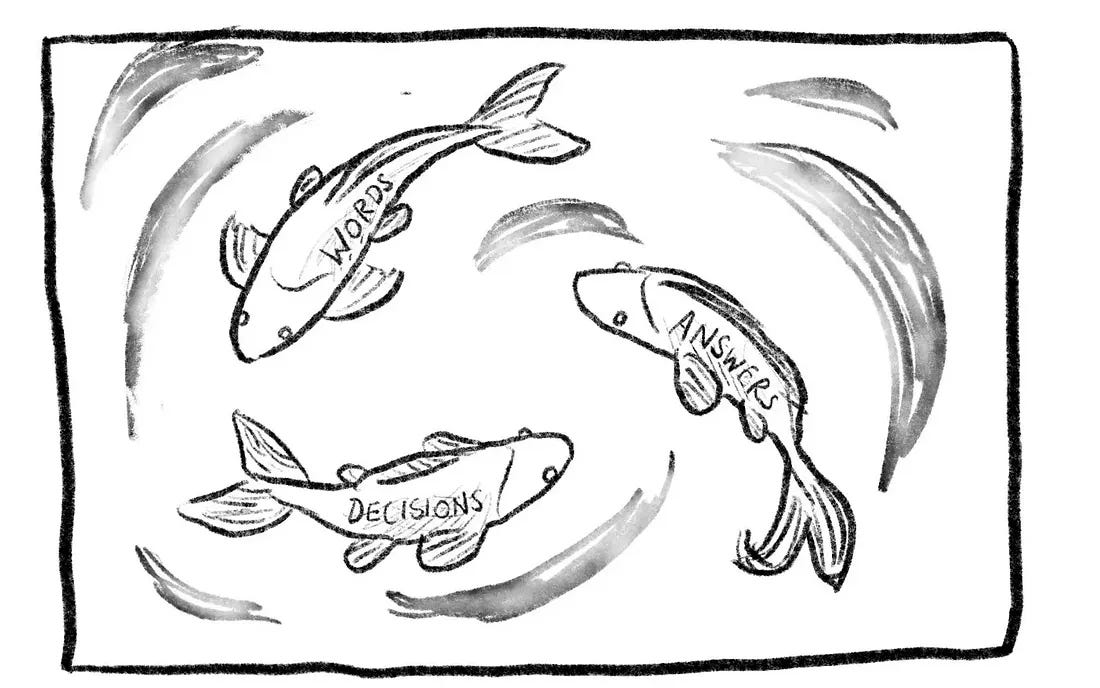
Being monotropic (the predominant attentional style of Autistics and ADHDers) can be beautiful, especially when we’re in a deep flow state with one of our passions. But it can also be painful, when we’re stuck in a loop going over and over the same difficult memory or problem, or we’re unable to start or stop something.
Sonny Hallett published this self-help guide to rumination and inertia, specially tailored to common Autistic and ADHD thought processes. Sometimes we know where the difficulty lies and what to do about it, but it can often take a lot more thought and consideration to really understand the roots or to move on.
Sonny notes that although rumination (going over and over the same thing) and inertia (struggling to get started or stop) can feel very different, they can share the same fundamental mechanics of monotropism.
Their guide offers prompts to support you through the process of working out what’s needed to move past the loop or being stuck. Sonny provides examples of ruminating ahead of a meeting and being unable to start cooking. However, the guide can be used flexibly to support you to unpick your thoughts, questions and feelings around pretty much any challenge.
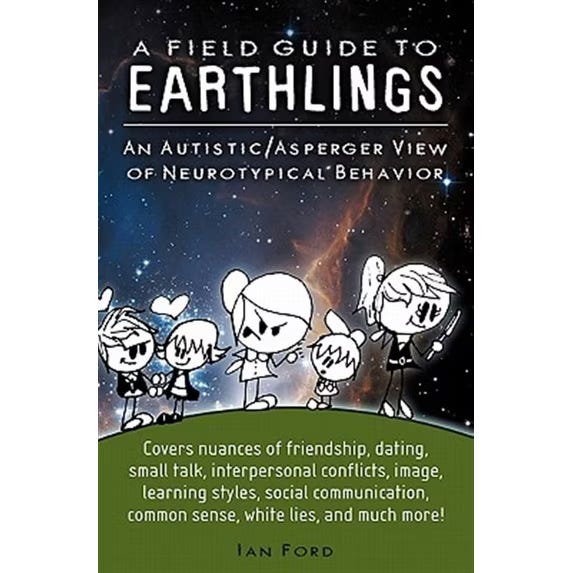
A FIELD GUIDE TO EARTHLINGS: AN AUTISTIC/ASPERGER VIEW OF NEUROTYPICAL BEHAVIOR
Book by Ian Ford (2006)
This is by far the oldest resource on the list - which you can probably tell by the title and its reference to Asperger.
Despite some outdated language and statistics, this is a book that many Autistics (and other Neurodivergents) still find helpful in understanding why so many people around them act the way they do. What it describes isn’t actually neurotypical behaviour, but neuronormative behaviour, which is privileged by society as a whole. People of any neurology are likely to be influenced by and try to conform to neuronormativity, to a greater or lesser degree. Neurotypicals are simply more able to do so successfully and with less effort.
This book was recommended to me by a supervisor while discussing how many people were looking for a resource to help them understand dominant social norms, small talk, and general neuronormative-style social skills.
Autistic and other Neurodivergent social skills are equally valid, and neuronormative social skills are not better. Research has indicated that different styles tend to work well when interacting with others who share the same style, though misunderstandings and communication challenges can still occur regardless. Neurotypicals still misunderstand and fall out with one another just as anyone else does, for example.
The double empathy problem highlights how responsibility for effective communication is a two-way street. Existing in the world that we do means it’s useful to understand people we want or need to interact with. Sometimes we might actively want to utilise neuronormative social skills, much like we might want to speak in another language.
Sometimes masking (adopting neuronormative ways of interacting both willingly or unwillingly, and consciously or unconsciously, is a type of masking) is forced on us as a matter of survival. It’s often the only way to access gatekept resources or services. It shouldn’t be that way, and no one should be forced to comply with neuronormativity. No one should be taught neuronormative social skills from the perspective that they are the only kind of social skills, nor that they are ‘correct’, ‘more acceptable’ or ‘better’ than any other type. They are not. We need to keep pushing for equal acceptance of Autistic and other Neurodivergent ways of being and for allistics (non-Autistics) and neurotypicals to learn divergent social skills and communication styles, while also having a choice to learn theirs too where that feels useful and possible as part of that two-way street.
To reiterate: Neuronormative social skills and communication styles are not better than Neurodivergent ones. No one should be made or expected to adopt them, nor should they be penalised if they do not.
I personally found this book extremely eye opening. It produced a lot of lightbulb moments, along with some sadness. The author identifies the neuronormative need to cling to existing ways of doing things until there is a readiness and willingness to move as a pack rather than as an individual, and change feels socially acceptable and emotionally safe. Along with the dynamics of power and privilege, this goes a long way to explaining why vital neuroaffirming changes are so slow to be enacted across society and systems, and such deep resistance is encountered, despite the overwhelming evidence of need.
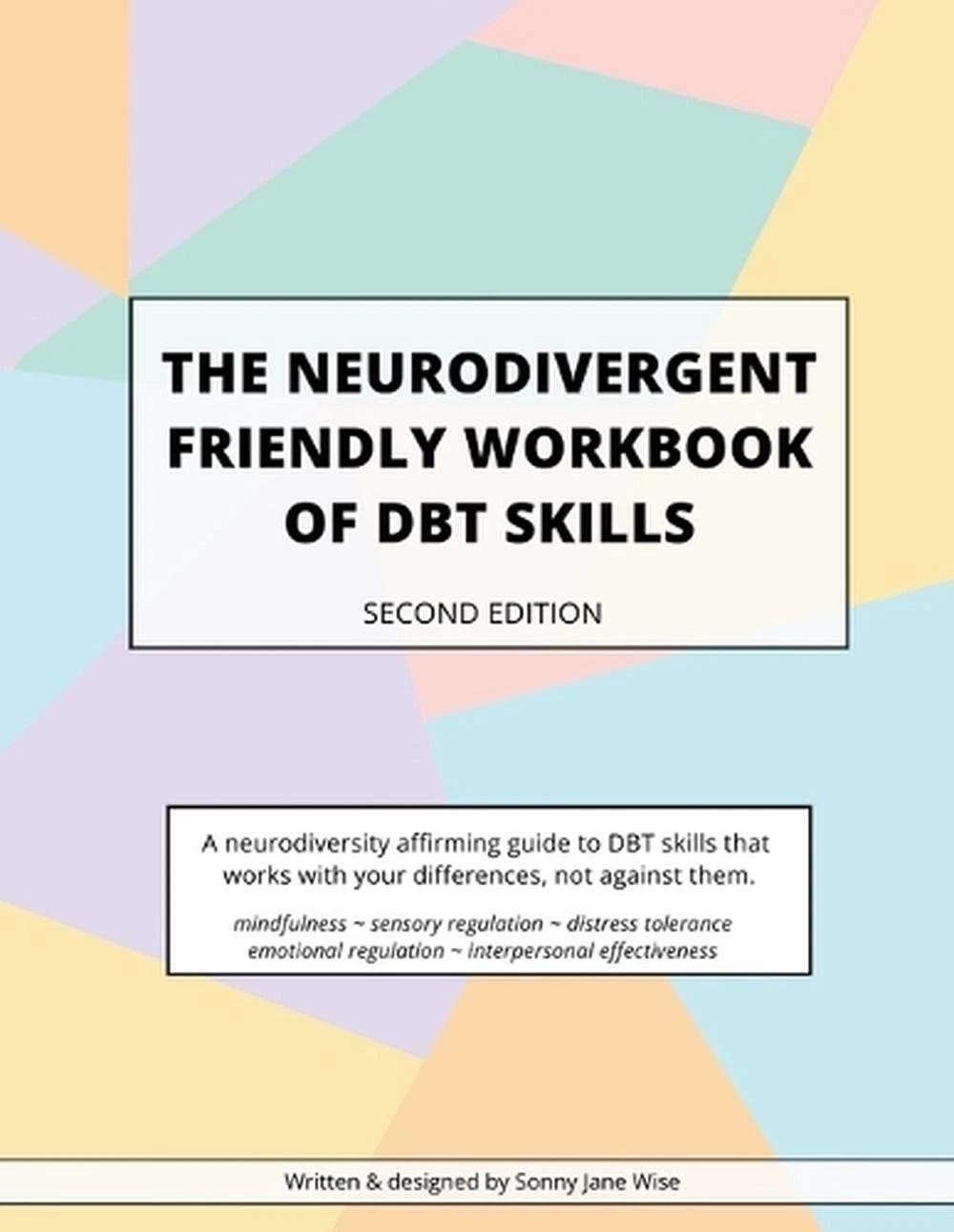
THE NEURODIVERGENT FRIENDLY WORKBOOK OF DBT SKILLS (SECOND EDITION)
Workbook by Sonny Jane Wise (2026)
I know, this is a fourth resource. I’m sneaking it in with the excuse that I don’t exactly signpost to this; I email a copy to almost everyone I work with because I have a clinical licence and it holds something of value for pretty much every Autistic and ADHDer.
Some clients go through through it cover to cover; some pop in and out of it as particular sections feel relevant; some bring parts to discuss in more depth in our therapy sessions; and some never look at it again after agreeing to me sending it through. Genuinely no judgement here.
The second edition (check you’ve got the 2026 version selected from the side menu) updates and expands on Sonny’s original workbook, tailoring DBT skills to make them neuroaffirming and supportive for Autistic and ADHD adults.
It covers everything from spoons, burnout and alexithymia, through sensory needs, mindfulness, meltdowns and communication. The workbook centres environmental and systemic factors and disability, while promoting whatever agency each individual does have to increase self-awareness and make changes where they’re possible and wanted.
Work with me
What I offer:
Online counselling for adults (18+). Sessions usually take place weekly, fortnightly, or on an ad hoc basis.
Rewind trauma therapy for PTSD symptoms can be carried out as part of counselling work or as a stand-alone therapy.
One-to-one neurodiversity discussion for anyone wanting to understand more, and ad hoc clinical consultation and supervision around neurodiversity for counsellors, therapists, mental health practitioners, education professionals and others.
I offer a free, 15-minute online video call for anyone who is interested in supervision, counselling or rewind trauma therapy with me and would like to find out more.
Please get in touch via contact@jadefarrington.com