
Three Essential Articles on Neurodiversity
Core ideas and concepts at the heart of the paradigm

If you subscribe to my monthly Neurodiversity Newsletter, you’ll be aware I love keeping up to date with the neurodiversity movement and discovering as much new content as I can.
Fresh pieces appear every week that have me questioning, reframing and unlearning what I ‘know’, or adding an extra perspective to my thoughts on a topic.
But there are some articles that don’t seem to age, and that stay current long after they’re published. These are the top three I find myself signposting to again and again.
NEURODIVERSITY: SOME BASIC TERMS & DEFINITIONS
By Dr Nick Walker
The ideas of neurodiversity, and the neurodiversity paradigm, brought with them a raft of new terminology. It can take time to learn and understand a whole different lexicon.
Unfortunately, that terminology is being misused in a range of different ways, and for different reasons.
Sometimes people have heard about ideas without being given the underpinning definitions, leading to misunderstandings like the idea that someone ‘has neurodiversity’; ‘is neurodiverse’; or has been ‘diagnosed neurodivergent.’
Language and the meaning of words evolves, but sometimes usage is simply inaccurate, or even deliberately co-opted. The neurodiversity paradigm stands in opposition to the pathology paradigm, but it’s now common to see those working within the pathology paradigm taking the language of the neurodiversity movement and using it to reinforce existing power structures and systems of pathologisation. Resisting that means ensuring we’re using language as accurately as possible and understanding its intended meaning.
You can read Nick Walker’s article outlining where common terms come from and what they mean here, or get his book, Neuroqueer Heresies, which includes the article.

WHAT IS NEURONORMATIVITY?
By Sonny Jane Wise
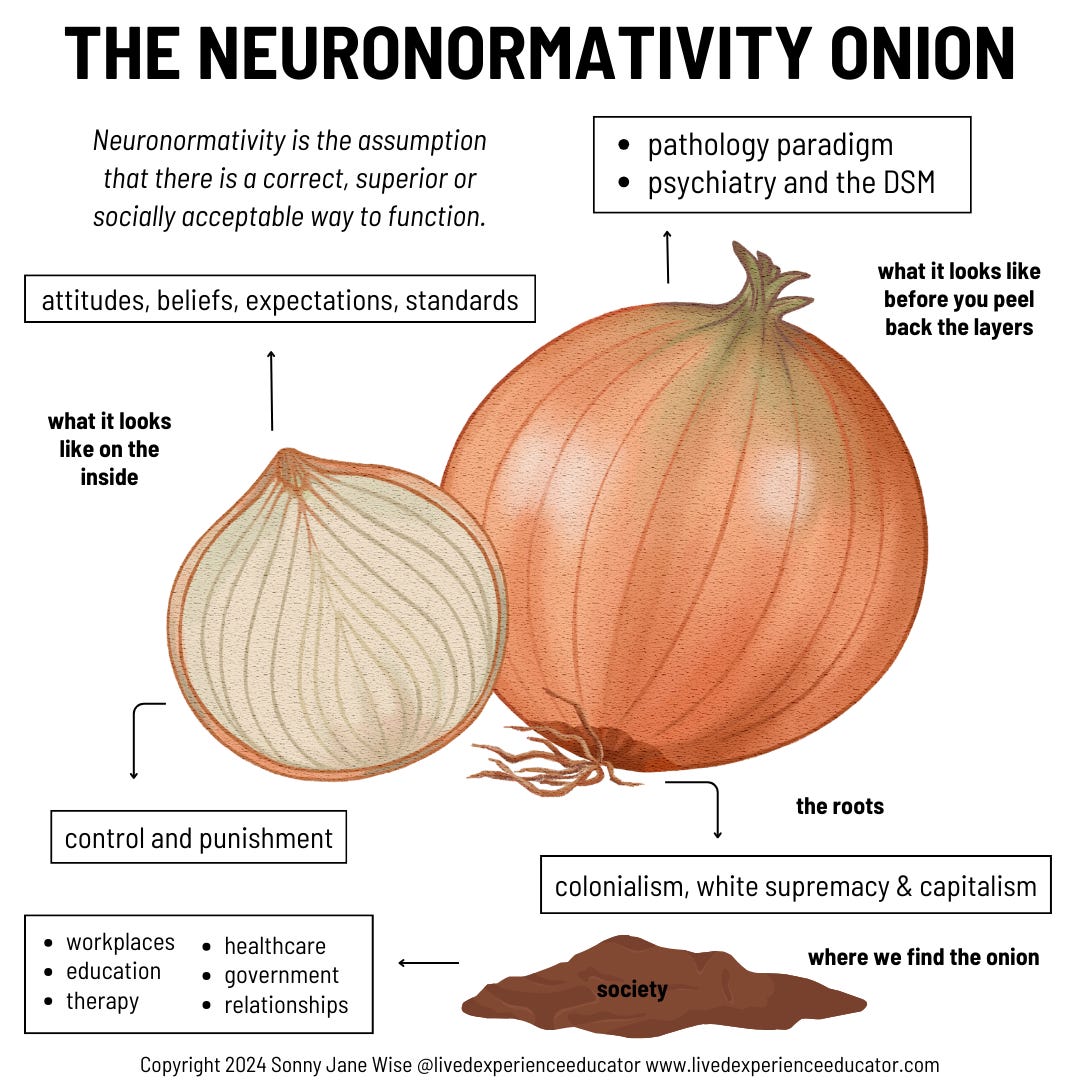
The term ‘neuronormativity’ was defined by John Lardas Modern in 2021*. I see it as one of the most important concepts for any neurodivergent person to be aware of, because neuronormativity has an enormous impact on our lives and the way broader society tries to make us function and comply.
I think this piece from Sonny Jane Wise does an excellent job of summarising what it means and why it’s so important, boiling it down to: “Neuronormativity is a set of norms, standards, expectations and ideals that centre a particular way of functioning as the right way to function. It is the assumption that there is a correct way to exist in this world; a correct way to think, feel, communicate, play, behave and more.”
In order to live in a neuroaffirming way we’re forced to challenge neuronormativity in our daily lives and in society. Most people have never heard of the term, but that doesn’t stop neuronormative attitudes being drilled into us from a very young age. Systems and institutions are built on it and perpetuate it.
You can read Sonny Jane’s explanation here.
*‘Neuronormative’ was used by Alyssa Hillary in a chapter in the 2020 publication Neurodiversity Studies; A New Critical Paradigm.
AUTISM AND ITS LABELS: DISORDER AND CONDITION
By Kieran Rose
The pathology paradigm labels those who diverge from neuronormativity as wrong, and in need or correction or cure.
‘Disorder’ is commonly used when medically diagnosing neurodivergent people. Our supposed deficits - the ways in which we fail to stack up to neuronormative standards - are catalogued in The Diagnostic and Statistical Manual of Mental Disorders (DSM) and the International Classification of Diseases (ICD).
Instead of recognising people as Autistic - an innate part of our being - we are labelled as ‘having’ Autism Spectrum Disorder (ASD), as if there’s an allistic (non-Autistic person) in there just waiting to be cured. Some have sought to soften this while continuing to pathologise, using the term Autism Spectrum Condition (ASC). But, as Kieran explains in his article, disorder and condition mean the same thing and are medically practically interchangeable. Both terms are incompatible with a neuroaffirming, neurodiversity paradigm approach.
This supposed softening has led to the paradoxical term ‘neurodivergent condition’ which takes its first word from the neurodiversity paradigm, and second from the pathology paradigm. The neurodiversity paradigm sees them as neurodivergences or neurotypes, while the pathology paradigm conceptualises neurodevelopmental disorders and conditions.
You can read Kieran’s piece here.
He has since expanded on this in Autism, its Labels and the Language of Pathologising Rhetoric which features in his new book, Autism: A Collection of Essays.
